Introduction: Asking the Right Question Is Half the Battle
“How can I earn money online?” — it’s one of the most searched questions on the internet, typed every single day by people in vastly different situations. A college student trying to cover rent. A parent who wants to work from home. A professional looking to diversify income beyond a single paycheck. Someone who just got laid off and needs a plan. Someone who simply wants more freedom.
The good news is that the answer to this question has never been more accessible. The digital economy in 2026 is enormous, diverse, and remarkably open to newcomers.
- You do not need a prestigious degree.
- You do not need startup capital.
- You do not need years of professional credentials.
You need an honest assessment of what you’re good at, the willingness to start imperfectly, and the consistency to keep going once you do.
The frustrating news is that the internet is simultaneously full of misleading, vague, or outright dishonest answers to this question. “Earn $5,000 per day watching videos.” “Copy-paste your way to six figures.” These headlines prey on genuine need, and they’ve made a lot of people skeptical of anything that sounds like online income.
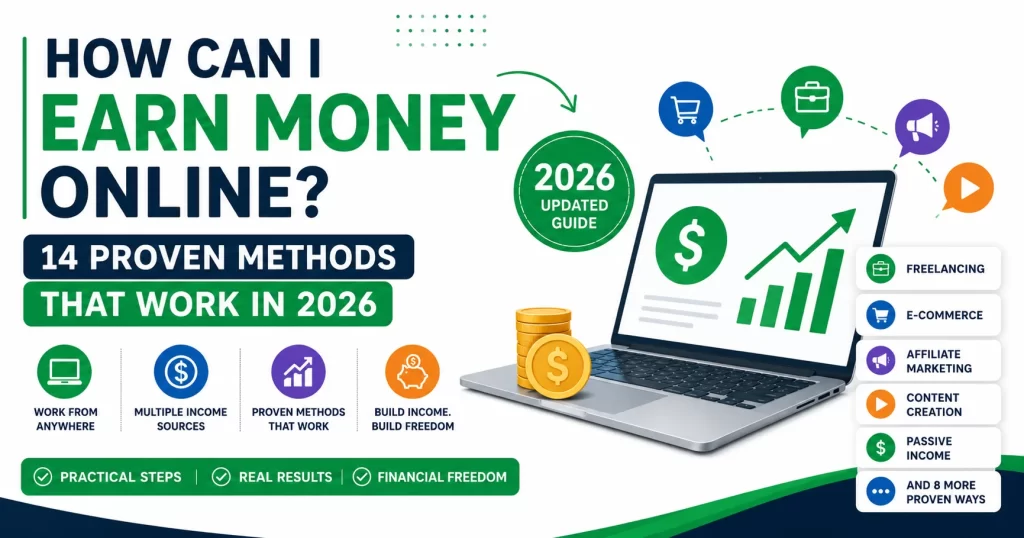
This article cuts through all of that. What follows is a detailed, honest breakdown of 14 proven methods for earning money online in 2026 — what they are, how they work, what platforms to use, what you can realistically earn, and what your very first step should be. No shortcuts, no hype, just a clear map of real opportunities.
Let’s answer that question properly.
Before You Start: Understanding the Three Types of Online Income
Before exploring specific methods, it helps to understand that online income generally falls into three categories — and knowing which category a method belongs to shapes your expectations and strategy.
Active income is earned in direct exchange for time and effort. You complete a task, deliver a service, or finish a project — you get paid. When you stop working, the income stops too. Freelancing and transcription work are active income. It’s the fastest path to cash, but it doesn’t scale without your continued presence.
Semi-passive income involves upfront work that continues to generate returns over time. You create a blog post, a YouTube video, or a digital product — and that asset keeps earning even when you’re not actively working on it. The work happens now; the income accumulates later. Affiliate marketing and selling digital products fall here.
Fully passive income — where money flows in with no ongoing effort — is mostly a myth online, at least in the beginning. Every passive stream requires significant active building before it can run independently. Don’t let anyone tell you otherwise.
The people who build the most sustainable online income typically combine one active method (for immediate cash flow) with one semi-passive method (for long-term growth). Keep this framework in mind as you read through the methods below.
1. Freelancing: The Fastest Answer to “How Can I Earn Money Online?”
If someone asks how they can earn money online and they need income relatively soon, freelancing is the most direct answer. It matches the skills you already have with clients who need those skills right now, and it requires nothing more than a free account on a platform and the ability to do the work.
Why Freelancing Remains Dominant in 2026
Businesses at every scale — from Fortune 500 companies to one-person startups — have fundamentally shifted how they hire. Rather than employing full-time staff for every function, they increasingly hire project-based specialists who can deliver specific results. This shift has created one of the largest and most active markets for skilled freelancers in history.
The most in-demand freelance services in 2026 include writing and copywriting, graphic design, web development, video editing, social media management, virtual assistance, SEO consulting, podcast production, email marketing, data analysis, translation, and digital advertising. If you possess any of these skills — or can learn one — you have something people will pay for.
Platforms That Connect Freelancers With Clients
Upwork is the world’s largest freelance marketplace, with 18 million freelancers serving clients across every industry. The platform actively promotes new accounts through a “Rising Talent” badge, which gives fresh profiles genuine visibility even without reviews. Upwork uses a “Connects” currency for submitting proposals, so use yours thoughtfully. Send 3 to 5 carefully crafted, personalized proposals each week rather than scattering dozens of generic ones. A proposal that shows you’ve read the job posting carefully and understands the client’s specific need will outperform a templated pitch every single time.
Fiverr operates on a listing model. You create a “gig” — a specific service with a clear title, detailed description, pricing tiers, and portfolio samples — and buyers find you by searching the platform. This model suits people who prefer inbound work over active pitching. Fiverr takes 20% commission on each sale, so factor that into your pricing. Start with competitive pricing to attract early reviews, then raise your rates as your profile builds social proof.
LinkedIn is an underrated freelance channel. A well-optimized LinkedIn profile that clearly states your service, your ideal client, and your results can attract direct inquiries from business owners, marketing managers, and startup founders — without platform fees or bidding wars.
PeoplePerHour and Freelancer.com are additional platforms worth exploring, especially in the early weeks when competition on the major platforms can feel overwhelming.
Realistic Income and Timeline
Most new freelancers earn between $150 and $500 in their first month while building their profile and landing initial clients. By month four to six, consistent freelancers commonly earn $1,500 to $4,000 per month. Specialists who narrow their focus — “landing page copy for health and wellness brands” rather than just “copywriting” — tend to progress faster because they attract better clients, face less competition, and can charge premium rates.
Your First Step
Create a free profile on Upwork or Fiverr today. Complete it fully — a profile with a professional photo, a clear headline, and a compelling service description gets significantly more attention than a bare profile. Create two or three work samples even if they are unpaid, and upload them as portfolio pieces. Send your first proposal or publish your first gig within 24 hours of signing up.
2. Content Writing: Steady, Scalable, and Always in Demand
Content writing is freelancing’s closest relative, but it deserves its own section because of how vast and consistently active the market is. All website needs words. Each blog needs articles. Every brand needs product descriptions, email newsletters, social media captions, and landing page copy. There are more clients needing written content in 2026 than there are writers available to produce it.
What Content Writing Involves
As a content writer, you research and write articles, blog posts, guides, product descriptions, and other written material for businesses that need to publish content regularly. You’re not typically creating advertising copy (that’s copywriting) — you’re creating informative, helpful content that attracts readers, builds brand authority, and supports search engine rankings.
This is one of the few online income methods where your primary tool is already inside your head. You don’t need software subscriptions, design tools, or technical skills. You need clear communication, research ability, and a reliable internet connection.
Where to Find Content Writing Work
Upwork and Fiverr both have enormous markets specifically for content writers. Textbroker, iWriter, and WriterAccess are platforms dedicated entirely to connecting writers with clients who need content — you sign up, complete a quality assessment, and begin receiving assignments matched to your skill level.
Pitching directly to blogs, digital agencies, and online publications often yields better rates than platform-based work, because you’re negotiating directly without middlemen or commissions. A well-crafted cold email to a content manager at a company you’d like to write for — demonstrating that you’ve read their existing content and have a specific article idea to pitch — can land you ongoing work.
Income Progression
Beginning content writers typically charge $0.05 to $0.08 per word, translating to $25 to $40 for a 500-word article. With a portfolio and a defined niche, rates of $0.15 to $0.25 per word are realistic — meaning a single 1,000-word article earns $150 to $250. Technical writers covering specialized fields like SaaS, healthcare, finance, or law command even higher rates, sometimes $0.30 to $0.50 per word, because the combination of writing ability and subject matter expertise is genuinely rare.
3. Affiliate Marketing: Earn Money by Recommending What You Trust
Affiliate marketing is the method most people point to when they imagine earning money online while they sleep — and it’s a legitimate possibility, but only after doing the work to build a platform that people trust.
How It Works
You join an affiliate program for free, receive a unique tracking link for a product or service, and share that link through your content — your blog, your YouTube channel, your social media, your newsletter. When someone clicks your link and makes a purchase, you earn a commission. You never handle the product, manage customer service, or deal with logistics.
The most accessible entry point is Amazon Associates, which covers millions of products and pays commissions of 3% to 10% depending on the category. Software and SaaS affiliate programs often pay 20% to 50% per sale. The most financially rewarding programs offer recurring commissions — meaning you earn every month a referred customer stays subscribed — which compound into significant monthly income over time.
What Makes Affiliate Marketing Work in 2026
The approach that converts has shifted significantly. Generic “best products” round-up posts stuffed with affiliate links no longer perform the way they once did. What works now is authenticity. Creators who actually use the products they recommend, who show how those products fit into their real lives, and who build genuine trust with their audience consistently outperform those who treat affiliate marketing as a numbers game.
You don’t need a massive audience to start. You need an audience that trusts your recommendations — and even a small, engaged following can generate meaningful affiliate income when the recommendations are relevant and authentic.
Building Your Affiliate Platform
You can share affiliate links through a free blog on WordPress.com or Medium, through a YouTube channel you start today, through Instagram or TikTok content, or through a newsletter. The platform matters less than the trust you build with whoever is on the other end. Choose a niche you know genuinely well, create content that helps your audience solve real problems, and integrate affiliate recommendations naturally into that content.
Income Timeline
Expect close to nothing for the first three to six months — this is the foundation-building phase, and it’s necessary. Between months six and twelve, consistent creators commonly reach $200 to $1,000 per month in affiliate income. By year two, those who have stayed consistent frequently report $3,000 to $10,000+ per month, much of it from content published months or years earlier.
4. Selling Digital Products: Create Once, Earn Repeatedly
Digital products represent one of the most economically elegant income models available online. You invest time and effort to create something once — a template, a guide, a course, a photo pack — and sell it an unlimited number of times without any additional production cost. No manufacturing, no inventory management, no shipping headaches.
What Sells Best in 2026
Canva templates are among the most consistently purchased digital products online. Resume templates, pitch deck designs, social media content kits, wedding invitation suites, business brand packages — these sell on Etsy and Gumroad to individuals and small businesses who want professional design without the cost of hiring a designer. Canva is free to use, so creating these templates costs nothing except your time.
AI prompt packs have emerged as a high-demand category that barely existed two years ago. Curated collections of well-crafted prompts for ChatGPT, Claude, or other AI tools — organized by use case, such as “high-converting e-commerce product description prompts” or “50 viral TikTok hook formulas” — are actively sought by marketers, content creators, and business owners looking to work with AI more effectively.
E-books and niche guides package specialized knowledge into downloadable formats. The crucial shift in 2026 is that buyers no longer want vague, general information. They want specific outcomes — a guide that takes them from point A to point B on a clearly defined problem. “How to land your first remote job in 30 days” sells better than “a guide to job searching.” Specificity is the difference between something that sells and something that sits.
Online courses — short, outcome-focused courses perform best in 2026. Massive 12-module programs have been largely replaced by tighter, faster-moving courses that deliver a clear transformation quickly. Platforms like Teachable, Gumroad, and Kajabi make hosting and selling courses straightforward without technical complexity.
Stock photography generates passive royalties. Every image you upload to Shutterstock, Adobe Stock, or Getty Images can earn small royalties each time someone downloads it. Building a catalog of 300 to 500 quality, searchable images creates a passive income stream that grows alongside your portfolio.
The One Rule That Drives Sales
Specificity converts. A Notion template “for freelance designers tracking client projects and invoices” will dramatically outsell “a Notion template for business.” A photography preset pack “for golden-hour outdoor portraits” will outsell “a photo editing preset pack.” Speak directly to a specific person with a specific problem, and that person will recognize themselves in your product description and buy.
5. Online Tutoring: Turn Academic Knowledge Into Consistent Income
If you have strong knowledge in any subject — mathematics, science, programming, a foreign language, music theory, history, English writing — online tutoring turns that knowledge into an hourly income without requiring a teaching degree or formal credentials.
The Logic Behind Online Tutoring as Income
The only real qualification for tutoring is being meaningfully ahead of the person you’re teaching. A university student strong in calculus can tutor high school students tackling it for the first time. A native English speaker who writes well can help non-native speakers improve their academic essays. A self-taught programmer who learned Python can teach complete beginners the fundamentals. The knowledge gap is your value.
What Subjects Have the Most Demand
Mathematics consistently sits at the top of demand for tutors across all age groups and markets. Science subjects — physics, chemistry, biology — follow closely, particularly around exam seasons. English writing and composition attract global demand, especially from students preparing for IELTS, TOEFL, or IELTS. Computer science and coding fundamentals have seen surging demand as the technology sector continues to grow. Standardized test preparation — SAT, ACT, GRE, GMAT — commands premium rates because the financial stakes for students are high and they’re willing to pay for quality instruction.
Platforms and Where to Find Students
Chegg Tutors, Tutor.com, Wyzant, and Preply are established platforms that handle student matching, scheduling, and payment processing. You create a profile, set your subject areas and availability, and conduct sessions via video call. Preply is particularly strong for language tutoring with a large international student base.
Beyond platforms, direct outreach is highly effective. Posting in relevant Facebook groups, university communities on Reddit, or on LinkedIn with a clear description of your subject and level of expertise can connect you directly with students — without giving up platform commissions.
Pay and Growth Strategy
Online tutors typically earn $15 to $30 per hour as beginners, rising to $40 to $75 per hour for specialized, high-demand subjects and experienced tutors with strong reviews. The path to the higher end is straightforward: accept your first 5 to 10 students at a slightly lower rate to build reviews, then increase your price with confidence. Specializing your positioning — “GMAT math specialist for business school applicants” rather than “math tutor” — makes you more discoverable and justifies premium pricing.
6. Online Coaching and Consulting: High-Value Work for Experienced Professionals
Online coaching and consulting represent the premium tier of the service-based online income world. The global coaching industry is projected to exceed $5.8 billion in 2026 and growing, while tech consulting alone is expected to surpass $400 billion globally. If you have genuine expertise in a professional domain — leadership, fitness, nutrition, career development, business strategy, marketing, financial planning, parenting, relationships, mental wellness — you can monetize that expertise at rates that service-based freelancing rarely reaches.
Coaching vs. Consulting: Understanding the Difference
Coaching is the practice of helping clients achieve their own goals through structured conversation, accountability, reflection, and guided growth. You’re not telling clients what to do — you’re helping them discover their own answers and build their own capabilities. Life coaches, executive coaches, business coaches, and wellness coaches all operate in this model.
Consulting is more directive. As a consultant, clients pay specifically for your expertise and recommendations. You analyze their situation, diagnose the problem, and prescribe solutions based on your professional knowledge. Marketing consultants, business strategy consultants, and technical consultants typically work in this mode.
Both are delivered online through video calls, making them geography-independent. You can build a client base globally without ever meeting anyone in person.
Income Potential Is Genuinely High
Entry-level coaches with a focused niche and a clear methodology typically charge $75 to $200 per session. Experienced coaches with a track record and strong positioning charge $300 to $600 per hour. Executive and business coaches at the top of their fields regularly charge $500 to $1,000 per hour.
Monthly coaching retainers — which provide predictable income for the coach and consistent access for the client — commonly range from $500 to $5,000 per month depending on the depth and specialization of the engagement.
What You Need to Get Started
The most important starting ingredients are genuine expertise, a clearly defined niche, and the ability to articulate the transformation you provide. “I help first-generation entrepreneurs build profitable online businesses” is a clear positioning. “I help people achieve their goals” is not.
The more specifically you can define who you help and what problem you solve, the easier it is to attract exactly the right clients and charge what your work is worth.
Build your initial presence through LinkedIn content, a simple website, and conversations with people in your network. Your first clients are very likely already in your existing professional or personal circle.
7. Blogging With Monetization: Build an Asset That Compounds Over Time
Blogging is simultaneously one of the longest-playing and highest-ceiling online income methods. A well-built blog in a focused niche does something remarkable: it becomes an asset. Content you write today can attract readers, generate affiliate commissions, and earn advertising revenue for years into the future. That compounding quality is what separates blogging from most other ways of earning money online.
Starting for Free
You can start a blog on WordPress.com, Medium, or Blogger at no cost. Medium’s Partner Program pays writers based on reading time from paid members — entirely free to participate in. If you want full control over your site and its monetization, self-hosted WordPress with basic hosting runs $3 to $8 per month — the closest thing to a minimal upfront investment in this guide.
Choosing a Niche That Actually Works
Your niche is the single most important decision in blogging. A niche that works has three qualities simultaneously: it’s something you can write about consistently without burning out, it has an active audience searching for information about it online, and it has clear monetization paths — affiliate products, display ads, sponsored content, or digital products that your readers would genuinely want.
“Personal finance for nurses” is a strong niche. “Budget travel tips for solo female travelers in Southeast Asia” is a strong niche. “Zero-waste living for apartment dwellers” is a strong niche. What these have in common is that they attract a specific, identifiable audience who can be converted into readers, subscribers, and eventually buyers.
Multiple Income Streams From One Blog
This is what makes blogging particularly powerful. A single blog can simultaneously earn from display advertising (Google AdSense or Mediavine pays you per thousand page views), affiliate commissions embedded in relevant articles, sponsored posts where brands pay you to write about them, and direct sales of digital products to your existing readership. These streams reinforce each other — more traffic means more ad revenue and more affiliate clicks; more trust means higher conversion on sponsored content and digital products.
Most blogs need 6 to 12 months of consistent content publishing before generating meaningful income. Think of that period as building an infrastructure that pays dividends for years.
8. YouTube and Content Creation: The Long Game With Extraordinary Upside
YouTube is one of the most powerful platforms for building compounding online income, and short-form video on TikTok and Instagram Reels has dramatically expanded the speed at which new creators can build audiences and earn income.
The Compounding Advantage
A video published today can earn views — and ad revenue, and affiliate commissions — for years if it ranks in search or continues to be surfaced by the algorithm. A library of 200 useful videos dramatically outperforms a library of 20, not just proportionally but exponentially. This means every video you publish is an investment, and the earlier you start building that library, the better.
Starting Without Expensive Equipment
A recent smartphone is entirely sufficient for YouTube video quality in most educational or talking-head formats. Free editing tools like CapCut, DaVinci Resolve, and smartphone editing apps can produce results that look professional without paid software. The competitive advantage in 2026 is not production quality — it is clarity, authenticity, and consistent delivery of genuine value.
Faceless channels — where a narrator explains topics over visual slides or stock footage — have grown significantly in popularity and work especially well for educational content covering finance, technology, history, science, and how-to topics.
How YouTube Earns Money
YouTube’s Partner Program, which unlocks ad revenue, requires 1,000 subscribers and 4,000 watch hours — a medium-term goal. But affiliate marketing through your video descriptions can begin generating commissions from your very first video. Brand sponsorships often arrive once you’ve built a few thousand engaged subscribers. Selling digital products to your audience is particularly high-converting because viewers who’ve watched multiple videos from you already have a strong sense of who you are and why they trust your recommendations.
On TikTok, the Creativity Program pays qualified creators for video performance. On Instagram, brand partnerships and affiliate sales through your link-in-bio drive income even with a modest but engaged following.
9. Virtual Assistant Work: Reliable, Flexible, and Beginner-Friendly
Every busy entrepreneur, executive, and business owner faces the same challenge: more to do than hours in the day. Virtual assistants solve that problem remotely, handling the organizational and administrative work that keeps a business running while the owner focuses on higher-level priorities.
What Virtual Assistants Do
The range of VA work is wide. Common responsibilities include managing and responding to email, scheduling appointments and meetings, conducting online research, preparing documents and reports, updating social media accounts, entering and organizing data, handling customer inquiries, managing project timelines, and basic bookkeeping. More specialized virtual assistants handle podcast editing, email marketing campaign management, social media strategy, or executive-level support for senior leaders.
Why This Is Ideal for People Entering Online Work
VA work is one of the few online income methods where you don’t need a portfolio or creative samples to get started. What clients care about most is reliability, attention to detail, and clear communication — qualities that demonstrate themselves in how you show up from the very first email. If you respond promptly, write clearly, and do what you say you’re going to do, you are already ahead of many applicants.
Entry-level VA work pays $10 to $20 per hour. Specialized VAs with expertise in social media management, email marketing, podcast production, or executive support routinely earn $35 to $60 per hour. With two or three steady clients at mid-level rates, virtual assistance can replace a full-time income entirely.
Finding Your First VA Client
Upwork and Fiverr both have active markets for virtual assistant services. LinkedIn is equally effective — search for solopreneurs, coaches, consultants, and startup founders who are growing quickly, and reach out with a personalized message explaining specifically how you can free up their time. Your pitch should be concise, specific about what you can do, and focused on their needs rather than your resume.
10. Dropshipping: Build an E-Commerce Business Without Holding Inventory
Dropshipping is a retail model where you sell products online without physically stocking them. When a customer orders from your store, you forward the order to a supplier who packs and ships the product directly to the customer. You never touch the inventory. Your focus is entirely on product selection, store design, and marketing.
Why Dropshipping Works
The dropshipping market has grown to a $476 billion industry, and it continues to expand because it removes the two biggest barriers to starting an e-commerce business: the need for startup capital to purchase inventory, and the logistical complexity of storing and shipping products. You can launch a dropshipping store and make your first sale without buying a single unit of anything.
How to Set One Up
Shopify is the most popular platform for building a dropshipping store. It’s designed for e-commerce, integrates seamlessly with supplier apps, and requires no coding knowledge. You choose a niche, find a supplier (AliExpress and CJ Dropshipping are popular starting points), import products to your store, write compelling product descriptions, set your prices with a profit margin built in, and drive traffic through social media content or paid advertising.
The most important strategic decision in dropshipping is niche selection. Stores that try to sell everything compete with Amazon and lose. Stores that focus on a specific, passionate community — eco-friendly pet products, ergonomic home office gear, minimalist hiking accessories — can build a recognizable brand that earns loyal customers.
What to Realistically Expect
Most beginners see their first sale within 2 to 6 weeks of launching, with active marketing. Net profit margins for dropshipping stores typically range from 15% to 20%, with well-optimized stores reaching 30%. Realistic timelines: 3 to 12 months of consistent effort to reach meaningful monthly income. Full-time dropshipping sellers commonly earn $2,000 to $8,000+ per month. Only 10% to 20% of beginners achieve consistent profitability in year one — not because the model doesn’t work, but because many quit before giving it a genuine chance.
11. Selling on Online Marketplaces and Reselling
Not every path to online income requires creating something from scratch. Reselling — buying items at a lower price and selling them at a higher price — is one of the oldest income models in existence, and online marketplaces have made it more accessible and scalable than ever before.
Physical Reselling
Physical reselling involves sourcing items from thrift stores, estate sales, garage sales, clearance sections, or wholesale suppliers, then listing them for sale at a profit on platforms like eBay, Poshmark, Depop, Facebook Marketplace, and Mercari. Branded and vintage clothing, electronics, sports collectibles, vintage furniture, and rare books are among the most consistently profitable categories.
This model requires some upfront capital for sourcing inventory, but it can also begin with items you already own that you no longer use. Many successful resellers started by clearing out their own closets and using the initial profits to fund their first sourced inventory.
Digital Reselling and Master Resell Rights
A growing category involves purchasing digital products — courses, templates, software tools — that come with “master resell rights,” meaning you can sell them to others and keep the full profit. This model requires careful vetting to ensure the products are high quality and the terms are legitimate, but done well, it allows you to earn from someone else’s creative work while building your own sales presence.
Part-time resellers operating 10 to 20 hours per week typically earn $500 to $1,500 per month within 3 to 6 months. Full-time resellers with strong sourcing channels and optimized listings can reach $3,000 to $8,000 per month.
12. UGC Content Creation: The Newest Way Creators Are Earning Real Money
User-Generated Content (UGC) creation is one of the fastest-growing income opportunities of the past two years, and most people outside the creator economy have never heard of it — which means the window of relatively low competition is still open.
What UGC Creation Is
Brands pay creators to produce short, authentic-feeling videos and photos showcasing their products. This content is used in the brand’s own paid advertising, social media feeds, email campaigns, and websites. The critical point that distinguishes UGC from influencer marketing: you do not need a following. You are not an influencer posting to your audience. You are a creator producing content that the brand publishes on its own channels.
Why does this exist? Consumers have become resistant to polished, scripted advertising. Research consistently shows that authentic, human-feeling content drives dramatically higher engagement and conversion rates than traditional ads. Brands have recognized this and are actively seeking creators who can produce that authentic quality — and they’re willing to pay for it.
What UGC Pays
Entry-level UGC creators charge $75 to $250 per video. Mid-level creators with a clear portfolio and repeat clients charge $300 to $500 per 60-second video. Full-time UGC creators managing multiple brand relationships simultaneously earn $4,000 to $8,000 per month consistently.
Finance and SaaS content pays the most: $300 to $600 per video because compliance requirements make these brands willing to spend for quality. Beauty and skincare ranges from $150 to $400 per video and has the highest volume of available work, making it great for beginners building a calendar.
Getting Started
You need three things: a smartphone with a decent camera, 3 to 5 sample videos made with products you already own (no brand relationship needed — these are portfolio pieces), and a profile on one of the dedicated UGC platforms. Billo, Collabstr, Twirl, and Influee are established platforms connecting UGC creators with brands. Collabstr hosts partnerships with over 130,000 brands across fashion, beauty, lifestyle, tech, and food.
The fastest path to consistent UGC income is combining platform work with direct pitching. Find brands on Instagram whose content looks like you could improve it, and send a brief, professional pitch with your sample work attached.
13. Transcription and Micro-Tasks: Simple, Immediate, Low-Barrier
Not every way of earning money online requires specialized training, technical expertise, or an impressive portfolio filled with past work. There are many beginner-friendly opportunities available for people who simply want to start earning as quickly as possible without spending months learning complicated skills. Transcription services and micro-task platforms are built specifically for this purpose, offering simple tasks that almost anyone can complete with basic computer knowledge, internet access, and consistency. These platforms provide an easy starting point for beginners who want flexible online work with a low learning curve and minimal upfront investment.
Transcription
Transcription work involves converting spoken content from audio or video files into clear and accurate written text. Popular platforms such as Rev, TranscribeMe, and GoTranscript offer opportunities for beginners and experienced typists alike, with pay rates commonly ranging from $0.45 to $1.50 per audio minute.
For fast and detail-oriented workers, this can translate to roughly $10 to $25 per hour. One of the biggest advantages of transcription is how quickly you can get started — many platforms approve applications and begin assigning projects within just a few days, making it one of the quickest online income methods for beginners.
Medical and legal transcription — which involves specialized terminology — pays higher rates but requires familiarity with the relevant vocabulary, often gained through free online resources before applying.
AI Micro-Tasks
The rapid growth of AI in 2026 has created significant demand for human reviewers, labelers, and testers. Platforms like Scale AI, Appen, Remotasks, and Amazon Mechanical Turk offer tasks including rating the quality of AI responses, labeling images for machine learning training, testing apps and websites for usability issues, flagging incorrect AI outputs, and evaluating search results for accuracy.
These tasks pay $3 to $15 per hour depending on complexity, and most can be started within hours of signing up. Think of micro-tasks as a zero-barrier entry point — a way to begin earning immediately while you develop skills in a higher-value method.
14. Online Surveys and Paid Research: Easy Money in Your Spare Time
Online surveys are the most accessible entry point on this list — and the most modest. They will not build life-changing wealth. But as a zero-effort supplemental income stream that fills otherwise idle time, they are genuinely worth understanding.
The Better-Paying Options
Most consumer survey sites pay $0.50 to $3.00 per survey, which adds up slowly. Prolific stands apart: it runs academic, behavioral, and commercial research studies and is widely respected for paying meaningfully better rates than standard survey platforms, with many studies paying $6 to $12 per hour equivalent. Respondent.io connects professionals and consumers with in-depth paid studies that can pay $50 to $200 per session. Online focus groups through platforms like CRNRSTONE and Farron Research pay $100 to $500 per session for an hour or two of your time — these are the highest-paying low-effort online income opportunities available to anyone.
How to Maximize Survey Income
Fill out your demographic profile completely on multiple platforms simultaneously. Studies are matched to participants based on their profiles, so a thorough profile unlocks more opportunities. Treat surveys as something you do during otherwise dead time — commuting, watching television, waiting for an appointment — rather than as a primary income strategy. As a supplement to your main method, they add meaningful money over a month without costing productive time.
How to Choose the Right Method for You
With 14 options in front of you, the most common mistake is trying to pursue several at once. The result is mediocre progress on everything and real progress on nothing. Focus is the single most important early decision.
Here is a practical framework for choosing based on your situation:
If you need income relatively quickly and have any marketable skill — freelancing or content writing are the fastest paths. You can have a live profile and active proposals within 24 hours.
If you want to build something that grows over time — blogging, YouTube, or affiliate marketing are the right foundation. Start building these now, alongside a faster-income method for immediate cash flow.
If you enjoy being on camera or interacting with people — UGC creation, online tutoring, or coaching aligns with your strengths. These are also among the highest-paying methods per hour of work.
Want a creative side hustle that can turn into passive income — selling digital products or building a dropshipping store offers the scalability that service work can’t match.
Looking for a simple online income idea with a low entry barrier — transcription, micro-tasks, or online surveys let you begin earning within days without any portfolio or pitching required.
For experts who want to share their knowledge and earn online — online coaching or consulting at premium rates is the most direct path to high hourly earnings.
The 7-Day Action Plan: From Reading to Actually Starting
The gap between people who build online income and people who read about it indefinitely is a single decision: to start, imperfectly and without all the answers.
Here is a practical first week:
Day 1: Choose one method from this guide based on your skills and goals. Write it down. Commit to it for 60 days before evaluating whether to add a second.
Day 2: Sign up for the primary platform associated with your chosen method. Complete your profile fully and professionally.
Day 3: Create 2 to 3 examples of your work — writing samples, design portfolio pieces, sample videos, a mock product listing. These exist to demonstrate what you can do.
Day 4: Submit your first proposal, pitch your first client, publish your first gig, or list your first product. The goal is not perfection — it’s taking the first real action.
Day 5 and 6: Review the response to your first attempts. Adjust your positioning, your pitch, or your pricing based on what you observe, not what you assumed.
Day 7: Reflect honestly. What did you learn? What would you do differently? Make one specific improvement and repeat the cycle. Every iteration makes the next attempt stronger.
Final Thought: The Answer Was Never Complicated
“How can I earn money online?” has a simple, honest answer: by delivering real value to real people consistently, through a channel that matches your skills and fits your life.
The methods exist. The platforms exist. The clients, the brands, the buyers — they are all out there right now, looking for what you can offer. What stands between you and your first dollar earned online is not information. It’s the decision to act on what you now know.
You asked the right question. Now take the first step.