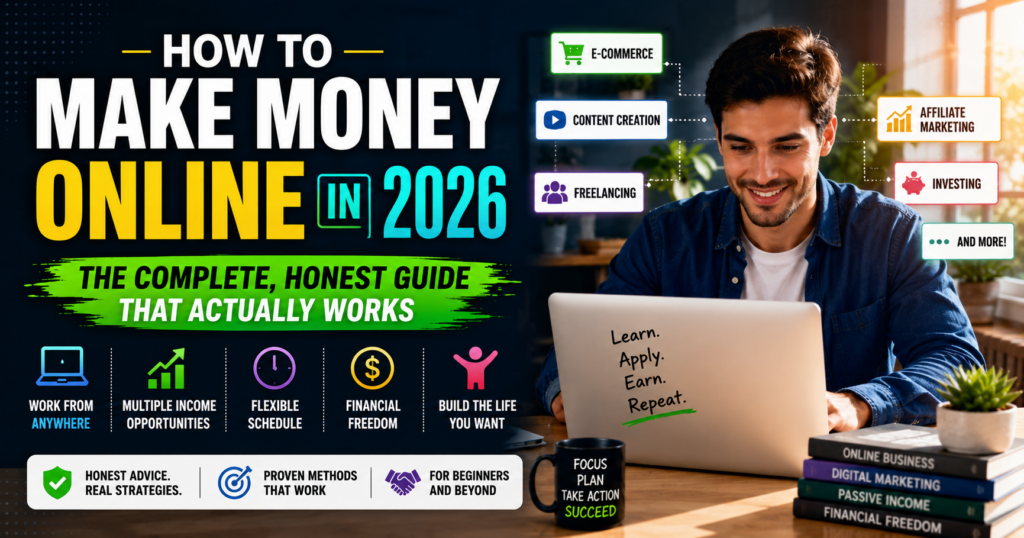
Introduction: The Online Income Opportunity Is Real — But It Requires the Right Approach
Let’s be honest with each other from the start. If you’ve landed on this page, you’ve probably already seen dozens of articles promising you can make $10,000 a month by next Tuesday doing almost nothing. That’s not what this guide is about.
Making money online is genuinely possible — more possible now than at any point in history. The numbers back this up. Freelancers alone contributed $1.5 trillion to the U.S. economy in 2024, and the global freelance market is now valued at nearly $10 billion, growing at close to 19% annually. That’s not a fringe movement. That’s a structural shift in how the world works.
But here’s what most guides leave out: earning meaningful income online takes real effort, a learning curve, and — most importantly — picking the right method for your skills and situation. The good news is that once you get traction, many of these income streams scale in ways a traditional job simply cannot.
This guide breaks down 10 of the most legitimate, proven ways to make money online in 2026 — covering what each method is, who it works best for, how to actually get started, realistic earning potential, and the common mistakes people make along the way.
1. Freelancing: Sell Your Skills Directly to Clients
Freelancing is, without question, one of the fastest and most reliable ways to start earning money online. The model is simple: you have a skill, businesses need that skill, and you charge them for your time and expertise.
What makes freelancing particularly compelling right now is the scale of demand. Over 76 million Americans now freelance, representing about 38% of the entire U.S. workforce. And on the hiring side, 99% of major employers plan to continue or increase their use of freelancers through 2026 and beyond.
What skills are in demand?
The highest-earning freelance skills right now fall broadly into these categories: software development and web programming, AI and machine learning, UX/UI design, digital marketing, copywriting and content strategy, video editing, and data analysis. If you have any background in these areas, you’re in an excellent position.
For those newer to the workforce, don’t underestimate entry-level adjacent skills either. Virtual assistance, social media management, customer support, basic graphic design, and transcription all have active markets and accessible entry points.
What can you realistically earn?
Earnings vary significantly based on skill and experience. Freelance web developers typically command $50 to $100 per hour. UX/UI designers average $60 to $120 per hour. Content writers usually range from $25 to $75 per hour. Importantly, 65% of freelancers who switched from full-time employment report earning more than they did at their previous job.
AI is also changing the earning curve rapidly. Freelancers who integrate AI tools into their workflow earn roughly 40% more per hour than those who don’t, and they save around eight hours per week on routine tasks — time they can redirect toward higher-value work or more clients.
How to get started
The major platforms are Upwork, Fiverr, Toptal, and Freelancer.com. Upwork is generally the best starting point for most people — it has 841,000 active clients and works well across nearly every professional category. Fiverr is strong for clearly packaged, productized services. Toptal is harder to get into (they accept only the top 3% of applicants) but pays premium rates.
Your profile is everything when starting out. Write a clear, specific headline that targets a niche rather than trying to appeal to everyone. “Email copywriter for e-commerce brands” will outperform “Copywriter” every time. Upload work samples, complete all profile fields (complete profiles receive 40% more inquiries), and be ready to write proposals that speak directly to the client’s problem rather than describing yourself.
The early weeks can be slow — most platforms take up to 48 hours to approve profiles, and landing your first client takes time. The key is persistence through that first month. Once you have a few reviews and a track record, your profile gains momentum.
2. Freelancing With AI: The Modern Edge
This deserves its own section because the opportunity is so significant. AI-related freelance skills are the fastest-growing category on every major platform. Prompt engineering demand has grown by 240% since the launch of ChatGPT. AI content editing is up 180%. AI tool training and integration consulting are both expanding rapidly.
This doesn’t mean you need a computer science degree. Many high-demand AI-adjacent roles simply require a solid understanding of how to work with these tools effectively. Helping businesses implement AI workflows, edit and refine AI-generated content for quality and accuracy, train custom AI models on company data, or build AI-powered automations are all areas where smart generalists with some technical curiosity can carve out a premium niche.
The practical takeaway here is that if you’re already a freelancer in any category — writing, design, marketing, development — layering AI proficiency onto your existing skills can significantly increase both your output and your hourly rate.
3. Creating and Selling Digital Products
Digital products represent one of the most powerful online income models available, and the reason is straightforward: you build the product once and sell it an unlimited number of times with almost no additional cost.
Think about what that means. A physical product requires raw materials, manufacturing, storage, and shipping for every single unit sold. A digital product — whether that’s an e-book, a template, a course, a preset, a tool, or a design asset — is delivered instantly, at essentially zero marginal cost, no matter how many people buy it.
What kinds of digital products work?
The key shift in what buyers want right now is specificity. Vague information products are dying. What sells is highly targeted solutions to very specific problems. An e-book called “How to Start a Business” faces fierce competition and skepticism. An e-book called “How to Get Your First 10 Freelance Clients as a Graphic Designer in 60 Days” speaks to someone who knows immediately whether they’re the intended buyer.
The formats that consistently perform well include:
- E-books and guides — Write about a specific problem you’ve solved. Platforms like Amazon Kindle Direct Publishing (KDP) let you self-publish and reach a global audience with minimal upfront cost.
- Templates — Notion templates, Canva design templates, spreadsheet templates for budgeting or project management, website themes, and email newsletter templates all have active, paying markets. Etsy is a surprisingly strong platform for digital templates.
- Online courses — If you have deep knowledge in any subject area, packaging that into a structured course can be both highly profitable and deeply satisfying. Platforms like Udemy, Skillshare, and Teachable provide the infrastructure. You focus on the content.
- Presets and design assets — Photographers sell Lightroom presets. Designers sell icon sets, font bundles, and illustration packs. Video creators sell LUTs (color grading tools). Creative professionals often underestimate the value of their aesthetic toolkit.
- Software and digital tools — More technical, but SaaS (Software-as-a-Service) products and browser extensions can generate substantial recurring revenue.
How to price and sell digital products
Pricing requires some testing, but a common mistake is underpricing. Low prices signal low value, and if someone is paying $7 for your e-book, they’re much less likely to actually read it and get results than if they paid $47. Courses at higher price points ($97–$497) with strong transformation promises routinely outperform cheaper alternatives.
For selling, you have several options. If you already have an audience, selling directly through your own website using a tool like Gumroad, Lemon Squeezy, or Podia keeps more revenue in your pocket. If you’re starting from scratch with no audience, marketplaces like Etsy (for templates), Amazon KDP (for e-books), or Udemy (for courses) provide built-in traffic, though they take a commission.
4. Affiliate Marketing: Earn Commissions by Recommending Products
Affiliate marketing is the practice of earning a commission for referring customers to another company’s product or service. You share a unique tracking link, and when someone clicks that link and makes a purchase, you receive a percentage of the sale.
It sounds simple, and the mechanics are simple — but most people approach it wrong and wonder why it doesn’t work.
What actually works in 2026
The affiliate marketing strategies that are generating real income right now have several things in common. They involve genuine personal use of the products being promoted. They provide real, honest opinions rather than surface-level “top 10” lists. And they focus on depth — explaining who a product is for, who it isn’t for, and what alternatives exist — rather than just pumping a product with superlatives.
The trust factor cannot be overstated. Audiences in 2026 have been exposed to so much shallow affiliate content that they’ve developed excellent radar for inauthentic promotion. The creators and bloggers consistently building affiliate income are the ones whose readers genuinely trust their recommendations.
Where to build your affiliate presence
You need a platform — a channel where people can find and consume your content. The most effective options are a blog (SEO-driven articles capture people who are actively searching for buying advice), a YouTube channel (video reviews and tutorials convert extremely well), and an email list (direct access to your audience, no algorithm dependency).
The best affiliate networks to start with include Amazon Associates (massive product catalog, lower commission rates), ShareASale, CJ Affiliate, Impact, and PartnerStack (for software/SaaS products, which typically pay 20–40% recurring commissions).
Realistic timeline and earnings
This is important to understand: affiliate marketing is not fast. A blog typically takes six months to a year before meaningful organic traffic arrives. A YouTube channel similarly requires consistency before the algorithm distributes your content widely. The people making $5,000 or $10,000 per month from affiliate commissions almost universally spent 12 to 24 months building before those numbers appeared.
The compensation for that patience is that once established, affiliate income is genuinely passive. A blog post you wrote two years ago can continue generating commissions every single month with no additional effort on your part.
5. Content Creation: YouTube, Blogging, and Social Media
Content creation as a business model has matured significantly. What once required luck and viral moments can now be approached systematically — though it still requires sustained effort and a realistic timeline.
YouTube
YouTube remains one of the most powerful platforms for building long-term online income. The monetization mechanisms are multiple and can stack: ad revenue through the YouTube Partner Program (requires 1,000 subscribers and 4,000 watch hours), affiliate links in video descriptions, brand sponsorships, digital product sales, and channel memberships.
The key to sustainable YouTube growth is finding the intersection between what you know well, what you genuinely enjoy discussing, and what people are actively searching for. Channels that focus on a specific niche — personal finance, cooking for beginners, software tutorials, home renovation, travel in a particular region — consistently outperform broad “lifestyle” channels.
Blogging
Despite regular obituaries being written for it, blogging remains a viable income source in 2026. The model has evolved, though. Thin, AI-generated content farms are getting penalized by search engines. What’s working is expert-driven content written with real experience and genuine specificity.
A blog generates income through display advertising (Google AdSense, Mediavine, Raptive), affiliate commissions, digital product sales, and sponsored posts. The upside of a well-established blog is significant — successful bloggers in profitable niches like personal finance, health, or home improvement can earn anywhere from $5,000 to $100,000+ per month, though these are outcomes built over years, not weeks.
Short-form video (TikTok, Instagram Reels, YouTube Shorts)
Short-form video has become a genuinely viable income platform rather than just a marketing tool. TikTok’s Creativity Program pays creators based on performance — to qualify, you need 10,000 followers and 100,000 video views in the past 30 days. TikTok Shop has also opened live shopping as a significant revenue stream for creators in product-adjacent niches.
Instagram Reels and YouTube Shorts serve double duty: they generate some direct ad revenue but more importantly act as discovery engines that funnel viewers toward your longer content, email list, or products.
6. User-Generated Content (UGC): Create Without an Audience
This is one of the most underrated opportunities in the current creator economy, and it solves a problem many aspiring content creators face: you can’t monetize until you have an audience, but you can’t build an audience without already creating content.
UGC (User-Generated Content) breaks that loop. Brands pay content creators to produce short videos, product demonstrations, and authentic-style reviews — not to post on the creator’s channel, but to use as advertising content on the brand’s own platforms.
The reason this model has exploded is that brands have discovered that relatable, authentic-feeling video content dramatically outperforms polished studio advertising in digital ad performance. They need a steady supply of it, and they don’t require the creator to have any following at all. They’re buying the content, not the audience.
What this looks like in practice
A brand ships you their product. You film a short video demonstrating it, reviewing it, or showing it fitting naturally into your daily life. You deliver the edited video (or multiple versions) to the brand, and they run it as a paid ad. You never have to post it on your own account if you don’t want to.
Pay for UGC work ranges widely — from $100 to $500+ per video depending on your track record, the brand, and the usage rights they require. It requires only a smartphone with decent quality, a well-lit space, and the confidence to speak naturally on camera.
Platforms like Billo, Fiverr, and directly pitching brands through Instagram DMs or LinkedIn are the most common ways to land UGC work.
7. Online Tutoring and Coaching
If you have expertise in any subject — academic, professional, creative, athletic, or personal development — online tutoring and coaching offer a direct path to meaningful online income with a relatively short ramp-up time.
The global demand for online education has continued expanding well past the pandemic-era surge. From K-12 academic subjects to professional skills like coding, Excel, or financial modeling, to personal development areas like fitness, nutrition, career coaching, and language learning, the market is broad and deep.
Platforms for online tutoring
For academic tutoring, platforms like Tutor.com, Wyzant, and Chegg Tutors connect you with students. For language teaching specifically, VIPKid (for teaching English to Chinese students), iTalki, and Cambly are well-established. For professional and creative skills, platforms like Clarity.fm (for business advice, billed by the minute) and Superpeers offer structured ways to monetize expertise.
Moving toward coaching
Coaching is a step up from tutoring in both scope and earning potential. Where tutoring tends to be session-based and skill-specific, coaching focuses on transformation — helping someone achieve a goal, navigate a challenge, or make a significant change in their professional or personal life.
Established coaches working with professionals on career transitions, entrepreneurs on business growth, or individuals on health and wellness can charge $150 to $500+ per hour, or package their work into $2,000 to $10,000 programs. The earning ceiling is high, but reaching it requires building genuine credibility through results, testimonials, and a clear articulation of who you help and how.
8. Print-on-Demand: Design Products Without Inventory
Print-on-demand (POD) is a business model where you create designs for physical products — t-shirts, mugs, hoodies, phone cases, tote bags, wall art — and a third-party service handles all the printing, packaging, and shipping only when a customer places an order. You carry no inventory and have no upfront manufacturing costs.
This model has a low barrier to entry and suits people who have visual creativity but don’t want to deal with the logistics of physical product businesses.
How it works
You create a design (using tools like Canva, Adobe Illustrator, or even AI image generation tools for certain styles), upload it to a print-on-demand platform, set your retail price (the platform takes its cut, you keep the margin above base cost), and list it in an online store. When a customer buys, the POD provider prints and ships the order, and you receive your profit.
The major POD platforms are Printful, Printify, Merch by Amazon, Redbubble, and Teespring (now Spring). Redbubble and Merch by Amazon provide built-in marketplaces, so you don’t even need a separate store. Printful and Printify integrate with Shopify, Etsy, or WooCommerce if you want to build a branded storefront.
What sells
The key to POD success is targeting specific niches rather than making generic designs. A t-shirt that says “I Love Dogs” competes with thousands of similar products. A t-shirt with a witty inside joke about a very specific dog breed — targeted at that breed’s passionate community — has far less competition and far higher relevance to its buyer.
Strong POD niches include professions (nurses, teachers, engineers), hobbies (hiking, fishing, gardening), sports teams and fandoms, family identity (“dog mom,” “plant parent”), and pop culture references within niche communities.
9. Dropshipping and E-Commerce
Dropshipping is an e-commerce model where you sell products online without holding any inventory. When a customer places an order in your store, you forward that order to a supplier who ships it directly to the customer. Your profit is the margin between what the customer pays you and what the supplier charges.
It’s a model with a low upfront cost and real income potential, but also one that’s more competitive and operationally demanding than many beginners realize.
The realistic picture
The margins in traditional dropshipping (sourcing products from platforms like AliExpress) have compressed as more sellers have entered the space and customers have grown more sophisticated about shipping times and product quality. The model that works well in 2026 focuses on carefully selected niches, reliable suppliers with reasonable shipping times, genuinely good product selection (not just “anything that’s cheap”), and strong marketing — particularly through Meta (Facebook/Instagram) ads or TikTok Shop.
Many successful e-commerce operators today blend dropshipping with private labeling — working directly with manufacturers to put their brand on products, giving them differentiation and better margins.
Platforms
Shopify remains the dominant platform for independent e-commerce stores. WooCommerce is a popular open-source alternative for WordPress users. For marketplace-based selling, Amazon FBA (Fulfilled by Amazon) is an entirely separate model worth its own research — it involves sending inventory to Amazon’s warehouses and leveraging their fulfillment and customer base.
10. Investing and Passive Income Streams
While the other methods on this list require active effort — at least initially — there are genuinely passive income opportunities online that can complement your active income.
Dividend investing
Buying shares in dividend-paying stocks or dividend-focused ETFs creates a stream of regular income that requires no active work beyond the initial research and ongoing portfolio management. Using an online brokerage like Fidelity, Schwab, or Zerodha (for Indian investors) makes this accessible to anyone. The key principle is dividend reinvestment — automatically reinvesting your dividends to compound returns over time.
High-yield savings and fixed income
In the current interest rate environment, high-yield savings accounts at online banks are offering meaningful returns. As of mid-2026, top-tier high-yield savings accounts offer around 4% APY — far above what traditional banks provide. This isn’t wealth-building at scale, but it’s effortless income on money that would otherwise be sitting idle.
Peer-to-peer lending and alternative investments
Platforms that facilitate lending directly between individuals or to small businesses offer higher potential returns than traditional savings instruments, though with correspondingly higher risk. These are not for everyone, but they represent one more lever for diversified passive income.
How to Choose the Right Method for You
With ten methods covered, the most common mistake is trying to pursue all of them simultaneously. That’s a path to burning out while making progress in none of them.
A more practical approach is to choose your starting point based on three honest questions. First, what skills or knowledge do you already have? Leveraging existing capability gets you to income faster than learning something from scratch. Second, how quickly do you need income? Freelancing is the fastest path to getting paid — often within weeks. Digital products and content creation take longer but eventually scale better. Third, how much time can you invest? Some methods (like blogging or YouTube) compound over 12 to 18 months of consistency. Others (like UGC or freelancing) reward effort more immediately.
The following framework is a useful starting point:
- Need income within weeks: Start with freelancing or UGC
- Have deep knowledge in a subject: Explore online courses or coaching
- Enjoy creating content and can commit long-term: Start a blog or YouTube channel
- Have design or visual creativity: Print-on-demand or digital templates
- Want mostly passive income eventually: Affiliate marketing or digital products (after building an audience)
Common Mistakes to Avoid
Chasing the “easiest” method rather than the right one. The easiest-looking method is rarely the most sustainable. Online surveys and microtask platforms pay pennies relative to time invested. They work as true supplements, not as income foundations.
Quitting before the inflection point. Many online income streams look like they’re failing for months before they suddenly work. A freelancer’s profile gets no inquiries for three weeks, then lands a steady client. A blog generates almost no traffic for six months, then an article starts ranking and brings in 5,000 visitors a month. The people who succeed are disproportionately the ones who stayed past the point where others gave up.
Ignoring the legal and compliance side. If you’re running a blog with affiliate links, you need proper disclosure. If you’re collecting email addresses, you need a privacy policy. If you’re earning freelance income, you need to understand your tax obligations. These aren’t exciting, but they matter.
Trying to do everything at once. Pick one method. Give it six months of consistent, genuine effort. Only then consider adding a complementary income stream.
Final Thoughts: The Real Secret to Making Money Online
There isn’t a shortcut. There isn’t a hidden method that only a few people know about. The people consistently earning significant income online have found an approach that fits their skills and personality, invested real time in building it, and stayed consistent long enough for compounding to work in their favor.
What has changed is that the tools available to help you — AI assistants, low-code platforms, global marketplaces, social media distribution — have never been more powerful or more accessible. The gap between having an idea and being able to execute it has narrowed dramatically.
The opportunity is genuinely there. Pick your method, start today, and stay the course.